Refrigerator type
French Door Refrigerator Repair
Two fresh-food doors over a freezer drawer — the most common premium layout, and the one with the most to go wrong at the door line.
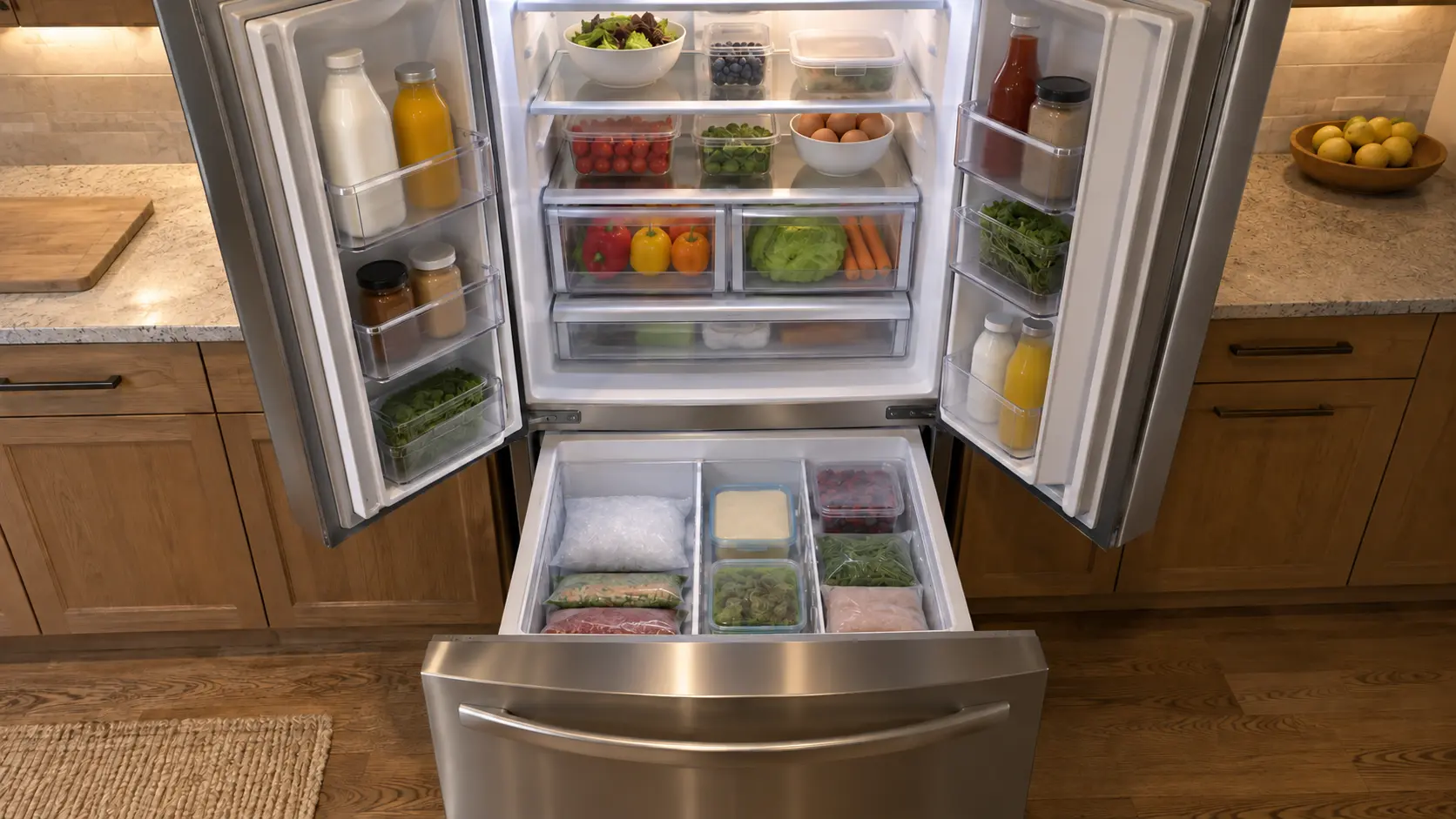
What this type is
A French door refrigerator puts two doors across the fresh-food compartment and a pull-out drawer underneath for the freezer. It is the layout most new refrigerators use, and its particular weak point is the middle: where two doors meet there is a hinged flap, and where the freezer drawer slides there is a gasket doing a harder job than a door gasket ever does.
How to tell yours is one
- Two doors side by side at the top, opening outward from the middle.
- A drawer rather than a door for the freezer, sometimes two drawers.
- A hinged strip on the left-hand door that folds as the door closes.
- Often a water and ice dispenser in one of the upper doors.
What fails on this type
Not a general list of refrigerator faults. These are the ones this design produces because of how it is built and where it is installed.
The mullion flap between the doors
The hinged strip that seals the gap between the two doors has to fold every time the door swings. When it sticks open the doors no longer seal against each other, and the compartment slowly loses temperature without any obvious noise or fault.
The freezer drawer gasket and rails
A drawer gasket seals on all four sides while carrying the weight of what is inside it. Loaded drawers, bent rails and a gasket that has taken a knock are a common source of frost at the front of the freezer.
Dispenser and water lines in the door
The water line crosses the hinge. It flexes every time the door opens, and it is the first place to look for a slow leak that appears at the front of the unit rather than underneath it.
Evaporator fan and defrost drain
With the freezer below and the fresh food above, a blocked defrost drain sends water forward into the drawer and then onto the floor instead of into the pan.
Getting at it
Access is the thing that most distinguishes one refrigerator type from another, and it is what decides how a visit is planned.
- Most of the common work is at the doors and the drawer, which means the unit stays where it is.
- Counter-depth models still sit in a cabinet gap and can be pulled forward, unlike a true built-in.
- Door-mounted dispensers make the left door heavy, and hinge wear shows first as doors that no longer line up.
- The defrost drain is reached through the freezer drawer, with the drawer removed.
Repair or replace
Most French door refrigerators are freestanding and replaceable without touching the kitchen, so the balance tips toward replacement sooner than it does on a built-in. The exception is a sealed-system fault on a recent, well-specified unit, where the repair is still clearly the cheaper answer.
Who makes them
The cross-brand view. A brand site cannot give you this, because it only knows its own.
Common problems on this type
Refrigerator Not Cooling
The compartment is warm but the appliance still has power and still makes noise.
Refrigerator Leaking Water on the Floor
Where the water appears matters more than how much of it there is.
Ice Maker Not Making Ice
When the freezer is cold, the question is whether water is arriving — not whether the appliance can freeze.
Refrigerator Water Dispenser Not Working
No water, slow water, or water that tastes wrong — three different faults sharing one button.
Refrigerator Door Not Sealing
A gap of a few millimetres is enough to frost an evaporator and run a compressor continuously.
Frost Building Up in the Refrigerator
Ice on the back wall, around the door, or over the whole freezer — and each location means something different.
Questions about french door refrigerators
Water is pooling at the front of my French door refrigerator. Where is it from?
The doors do not seem to seal in the middle.
Is a counter-depth French door the same as a built-in?
Back to your everyday
Let’s get your refrigerator working again.
Three short steps online, or one call. Tell us what you are seeing and pick a window that works.
Not a refrigerator? Each of these is its own appliance, and has a site of its own.
- Freezerstandalone upright freezers
- Ice makerstandalone and undercounter ice machines
- Wine coolerwine cabinets