Refrigerator problem
Freezer Not Freezing
Soft ice cream and refreezing frost, or a cabinet that has gone entirely warm.
What this usually means
A freezer that is cold but not cold enough is a different fault from one that is not cold at all. The first points at airflow, defrost or a door; the second at power, controls or the sealed system. On a standalone freezer there is a third possibility that has nothing to do with the appliance: the room it stands in may be colder than its own set point.
Five observations that narrow it
Answer these before anyone visits. Each one removes a whole branch of the diagnosis, and they cost nothing.
Is it slightly warm or completely warm? Soft ice cream and thawed meat are different faults.
Where is the freezer installed, and is that space heated?
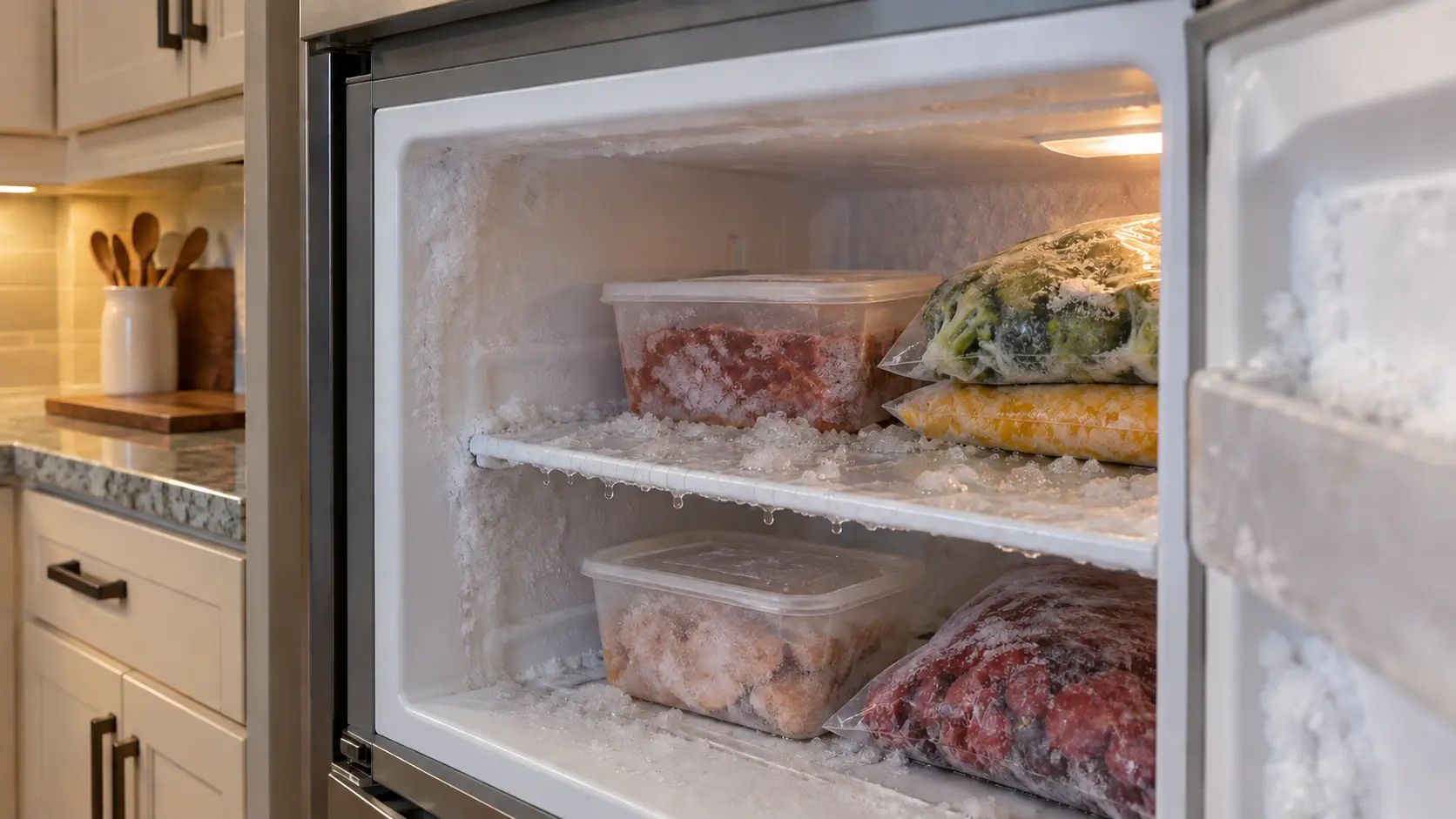
Is there frost on the walls, and is it soft and wet or hard and clear?
Does the compressor run, and does it run all the time or not at all?
For a chest model: is it manual-defrost, and when was it last defrosted?
Causes, cheapest first
In roughly the order a technician rules them out. The expensive answer is at the bottom because it is usually the last one true, not the first.
Door or lid not sealing
lowestA lid held open by a fraction, or a hardened gasket, admits humid air continuously. On a chest freezer this is the most common cause by a wide margin.
See refrigerator door not sealingManual defrost overdue
noneThick ice on the walls of a manual-defrost freezer is maintenance rather than a fault, and no part needs replacing.
Ambient temperature below the set point
noneA freezer in an unheated garage stops cycling when the room is already cold, and the contents drift toward the room temperature. A garage-rated unit handles this; one that is not, cannot be repaired into it.
Defrost failure on an automatic model
low to moderateFrost over the evaporator blocks the air path until the cabinet can no longer hold its temperature.
Condenser starved of air
lowestA coil packed with dust, or a unit pushed tight against a wall, leaves the compressor running without gaining ground.
Sealed system or compressor
highestA cabinet that is entirely warm with no compressor noise is where this becomes the likely answer, and on a chest freezer it is usually the point at which replacement wins.
Check these before you book
- Check whether the door or lid closes fully and that nothing inside is holding it open.
- Find out whether the model defrosts automatically or manually before assuming ice is a fault.
- Note the temperature of the room the freezer stands in.
- Listen for the compressor and say whether it runs constantly, intermittently or not at all.
- Have somewhere cold ready for the contents; the cabinet usually has to be emptied for any real work.
Food safety
Food that has fully thawed should not be refrozen. A full freezer holds its temperature for roughly 48 hours with the door kept shut, and a half-full one for about 24, which is usually enough time to arrange a visit.
What fixes it
The work behind the causes above, with what it costs relative to the rest.
Related problems
Frost Building Up in the Refrigerator
Ice on the back wall, around the door, or over the whole freezer — and each location means something different.
Refrigerator Not Cooling
The compartment is warm but the appliance still has power and still makes noise.
Refrigerator Door Not Sealing
A gap of a few millimetres is enough to frost an evaporator and run a compressor continuously.
Refrigerator Running Constantly
The compressor never cycles off, and the cabinet may still be holding temperature.
Back to your everyday
Let’s get your refrigerator working again.
Three short steps online, or one call. Tell us what you are seeing and pick a window that works.
Not a refrigerator? Each of these is its own appliance, and has a site of its own.
- Freezerstandalone upright freezers
- Ice makerstandalone and undercounter ice machines
- Wine coolerwine cabinets